Also from Sydney: Public, for Whom? The struggle for public space →
Part I · Sydney, March 2025
The rise, regression, and revival of terrace houses.
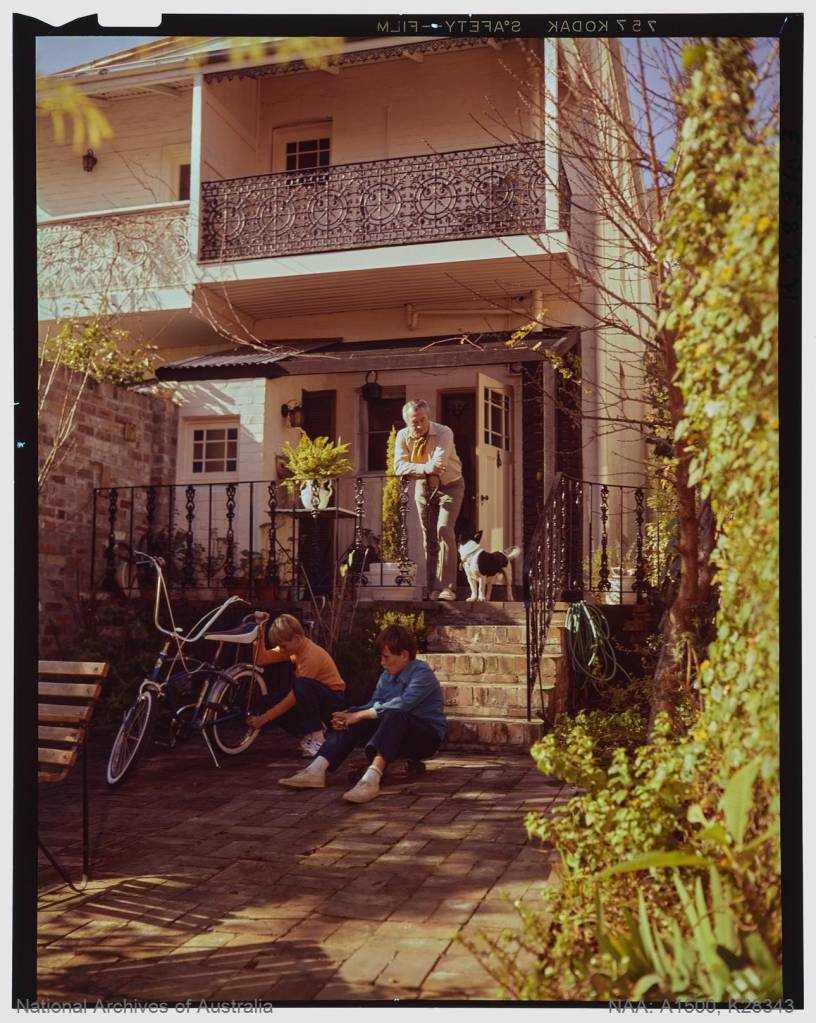
As one wanders through Sydney’s neighbourhoods, they repeatedly encounter a familiar style of urban dwelling: the terrace house, as seen in the National Archives of Australia’s photograph. Utilitarian in character, the three-storeyed home is adorned by an ornate filigree cast-iron balcony, accompanied by a front-facing veranda which looks over an enclosed courtyard speckled with potted ferns and laid brick (Rolfe, 1962). The National Archives image showcases the resurgence of the terrace home for young, middle-class families, such as the one shown.
It is imperative to juxtapose the image with the historical context of the earliest inhabitants of terrace houses. Terraces were built in a conjoined manner with the objective of maximising profits for developers (Thompson, 2010). Small lot sizes meant more homes on less land. The affordability and practicality of the properties enabled upwardly mobile blue-collar workers in the 19th century to attain homeownership.
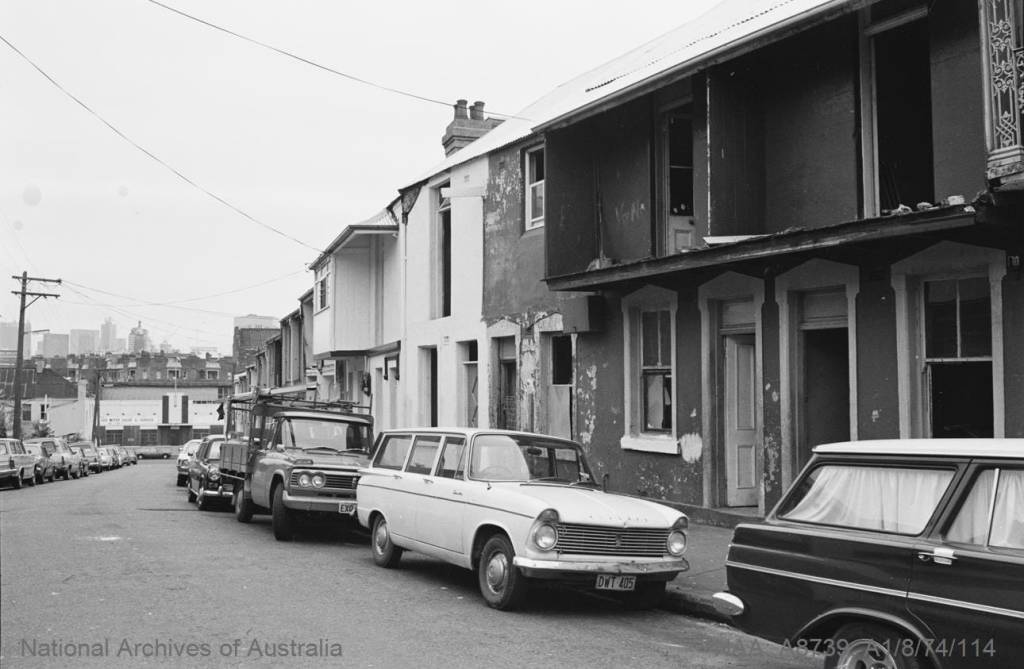
As the new century unfolded, terrace homes became synonymous with ‘slums’ in the Australian imagination, due to high density and unlivable conditions. A 1907 Evening News first-hand account scornfully detailed a homeowner terrorised by ‘raucous roosters’ and the stench from a neighbour’s poultry, which he blamed for the chronic illness afflicting his household. A beacon of upward mobility lost its glamour as terraces became insanitary and overpopulated. Mass exodus towards outer-ring suburbia followed.
Yet around the 1960s and 1970s, the once abominated home came back into fashion. Sydney’s terraces saw the rise of gentrification and swaths of renovation, with the toilet brought indoors and kitchens rebuilt to support families. As the image displays, terraces appealed to younger skilled labour, seeking to start families and commute by foot, bike, or public transit (Spearritt, 1973). This marks the end of the terrace’s utilitarian days, though not a turn towards egalitarianism: the same homes, now held by a different class.
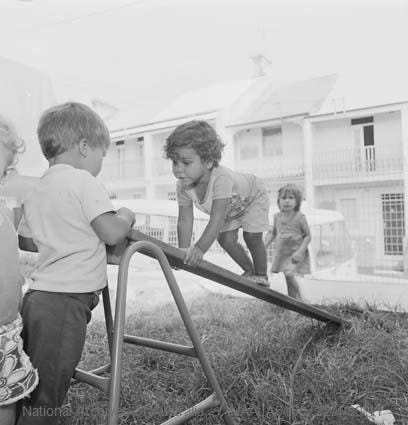
When Sydney decided these homes were worthless, and when it decided they were precious, the excuse was the facade. But it was always about those standing on their terrace.
Sources
“Poultry in Terrace Houses.” The Evening News, 7 February 1907, 8. nla.gov.au/nla.news-page12201375.
National Archives of Australia. Housing – Homes and Homesteads – Terrace Houses in Paddington Area. Photograph, A1500, K28343, 1971. Item ID 11781096. Sydney.
Rolfe, Patricia. “Terrace Houses.” The Bulletin 84, no. 4315 (October 1962): 12–14. nla.gov.au/nla.obj-673244601.
Spearritt, Peter. “The Australian Slum Stigma.” The Australian and New Zealand Journal of Sociology 9, no. 2 (August 1973): 41–44. doi.org/10.1177/144078337300900209.
Thompson, Ruth. Sydney’s Flats: A Social and Political History. Macquarie University, August 2010. doi.org/10.25949/19442285.v1.
“Archives, Articles and Records,” University of Sydney, March 2025. AI was used to check grammar, punctuation, and spelling, as disclosed at the time.

