Issue brief and policy proposal · Colorado · 2022
The state legislature has never defined what “navigable” means and what constitutes private landowners from closing off river access.
Where it stands, October 2026
On June 5, 2023, the Colorado Supreme Court ruled unanimously in the Hill v. Warsewa case (State v. Hill, 2023 CO 31) that Roger Hill lacked standing to seek a declaration that the riverbed belonged to the state, and it did not decide whether that stretch of the Arkansas River was navigable. Lawmakers last tried in 2010, when a narrower bill protecting commercial rafting, the Commercial Rafting Viability Act (House Bill 1188), passed the state House and stalled in the Senate. No river access bill was introduced in the 2026 session, and the debate has carried past 2026. The legislature still has not defined navigability.
Part I. Issue brief: Colorado Schism of Waterway Access and Navigability
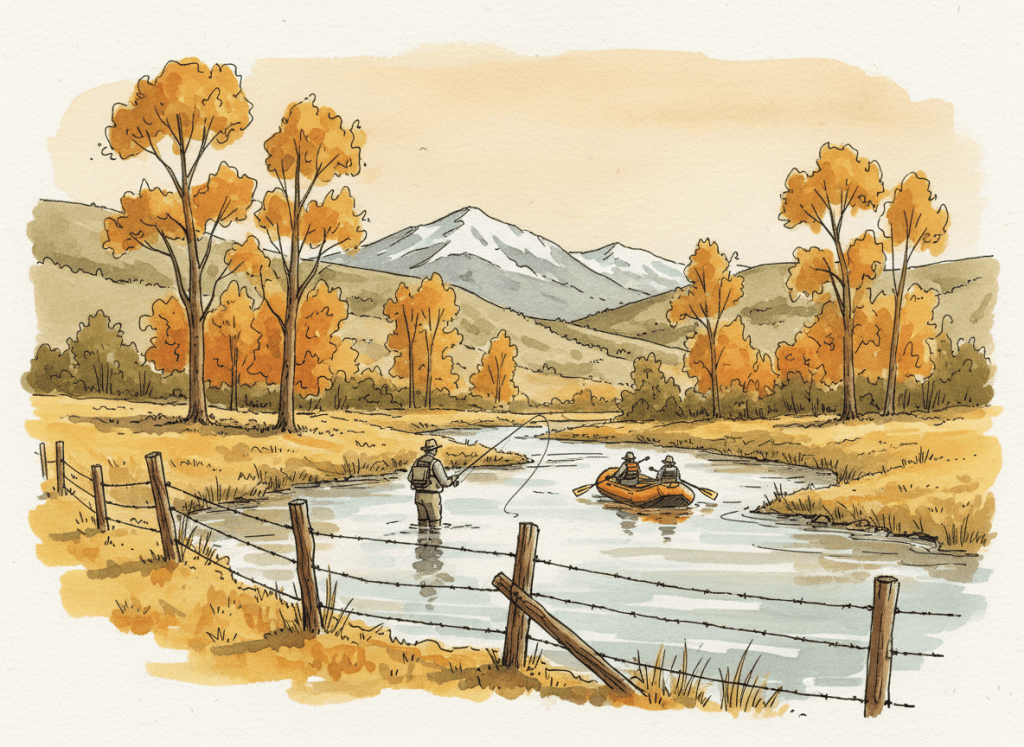
Colorado is home to over 100,000 miles of rivers, which entails an abundance of recreational activities ranging from fishing to water rafting.[1] Except, Colorado is unique in the sense that it allows private property owners to cut-off the general public from accessing waterways that run through or alongside their property that they deem “non-navigable”. The state legislature has never defined what “navigable” means and what constitutes private landowners from closing off river access.
Navigability Background
Federal United States law states that navigable waterways are to be regulated by the states. Most states across the United States interpret this to mean that the public can access these waterways since they are public lands. Whereas, Colorado’s Supreme Court in In re German Ditch & Reservoir Co., 56 Colo. 252 (1913) has suggested that all their rivers, streams, and creeks were non navigable.[2] What was established is that the private ownership of these “non-navigable” waterways is reserved to be determined by the properties that neighbor them.[3] The state legislature has never explicitly defined what a navigable river it leaving it to the property owners to determine for themselves.
Access Background
In a state supreme Court case, People v. Emmert outlines that Colorado statutes implies a recognition of property owners to control the public’s access to the waterways that run through their property.[4] It outlines that it is unlawful to enter upon privately owned land to hunt or fish without gaining permission from the landowner.[4] At the same, liability is reduced to encourage landowners to make land and water accessible for recreational activities.[6]
Hill v. Warsewa
Hill, the plaintiff alleges that the river he was fishing in what was a navigable riverbed, meaning that he and the public should have access to the river. The defendant, Warsewa, argues that the water was non-navigable which means he, and other property owners, retain the right to cut off public access to waterways and riverbeds that adjoin their property. The question at the basis of this case is what does navigability mean, seeing that there is no definition in Colorado state law. The implications from this appeals court decision siding with the plaintiff opens thousands of miles of rivers that were once purchased privately to the public.[7] Additionally, Colorado Court of Appeals and a district court have outlined that Hill had failed to provide evidence that showed he had a legally protected right. But the Court of Appeals did state that Hill would be allowed to seek a court order that blocks landowners from denying access to the river due to possible historical evidence of the title of navigability during statehood.
Private River Advocates
The privatization of waterways coalition is composed of private property owners, ranchers, real estate organizations, as well as the Colorado executive branch. The coalition argues that landowners should retain the right to choose to make their streams and rivers accessible to the general public. If they don’t retain this right, they question whether or not they would be compensated for their purchase of land that incorporates a waterway adjoining the property that is being taken for public use. The public taking of waterways also brings up concerns for private fishing clubs in the state that rake in hundreds of thousands of taxable dollars.[8] Additionally, the public taking of waterways opens up legal complications of property rights, standing access agreements, and the defining of navigability of every river and stream as noted by Phil Weiser, Colorado State Attorney General.[9]
Public River Advocates
The second coalition includes a wide array of interests from fishermen, boaters, rafters, and environmentalists. They see rivers and waterways as a common good that should be held in public trust for the benefit of the state’s citizenry, not private individuals.[10] They cite historical evidence that refers back to the state’s inception that as long as a river was navigable then for commerce, they today have a right to access that body of water since it would fall under state control.[11] Businesses who operate on private waterways thanks to permission by landowners worry about being at the mercy of landowners who could all of a sudden prevent these businesses such as fishing guides and white water rafting companies from operating.[12]
Environmentalists argue that the privatization of “the commons” leads to habitat destruction, which is another reason for public taking of these waterways.
What’s Next
Hill v. Warsewa will be litigated in front of the Colorado State Supreme Court. The legislature as well as the Governor’s office have both refrained from taking a position on the matter, leaving it in the hands of the state’s Supreme Court. If the court sides with the plaintiff, this would have an immense impact on the state government by requiring every stretch of river and streams to be surveyed and classified. It also complicated private property rights, taxes, borders, and much more. But at the same time, it would aid in the boost of the Colorado recreation economy. The best decision for the Governor is to call on the legislature to define the laws, except seeing that the State Supreme Court is already set to rule on this matter.
Part II. Policy proposal: a letter to Governor Polis
Dear Governor Polis,
Colorado is home to over 100,000 miles of rivers, which entails an abundance of recreational activities ranging from fishing to water rafting. Except, Colorado is unique in the sense that it allows private property owners to cut off the general public from accessing waterways that run through or alongside their property that they deem “non-navigable”. The state legislature has never defined what “navigable” means and what constitutes private landowners to be able to close off river access. So the line has always been blurred at what constituted access denial. Currently, the Colorado Supreme Court is reviewing a case that will uphold either party’s right to access riverways. Whatever the Supreme Court decides will ultimately favor one side over the other. There will be friction stemming from whichever way the ruling goes. To prevent conflict from arising, a solution proposal is necessary.
This policy proposal hinges on whichever way the Colorado Supreme Court rules. The proposal would apply to landowners if the court rules in their favor. If property owners do win, they would be granted the right to determine who accesses waterways that flow through or adjoin their property. Landowners cutting off fishers and water rafters from utilizing rivers would bring about conflict. Not only would this apply to private actors, but businesses as well such as fishing guides, water rafting, and more. The implications would disrupt Colorado’s large recreational economy. Additionally, there would be further complications pertaining to where one can and cannot access riverways.
The first aspect of the policy proposal to appease both parties would be granting property owners a tax break if they were to allow public access to the adjoining waterways. This would be turned into a ballot initiative seeing that it pertains to taxes. But with the backing of the Governor, the likelihood of passage would heighten. The reasoning behind this proposition is that it allows the public to still have access while simultaneously incentivizing property owners.
The second feature would be to define the legality of access. According to Water Education Colorado, a non-profit in Denver, some ways in which to resolve complications would be “for landowners: whether they have the ability to protect assets such as private fisheries, what barriers constitute criminal obstruction, do they need additional liability protection from instances where a boater might incur injuries floating through the property, and how to protect their privacy.” These are all issues that would be sorted out by either the ruling by the Supreme Court and if they don’t clarify, it then falls upon the Colorado State Legislature to settle the issues laid forth. Furthermore, the same provisions apply to pertain to rafters, such as establishing “protection[s] against incidental contact and guidance on whether certain activities are allowable: dropping anchor, eddying out, standing in the river to dislodge a stuck raft, fishing or portaging around hazardous obstructions.”
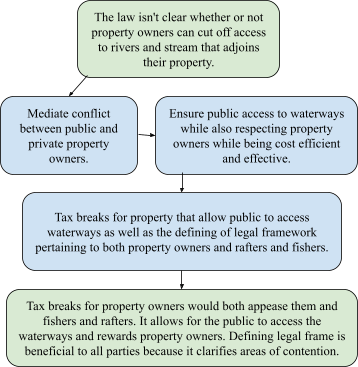
The benefit of this approach of utilizing ballot initiatives is that it comes at little cost to the government. The vast majority of funding relating to the initiatives comes from campaign contributions whether that being private individuals or non-governmental organizations. Pertaining to the defining of the issue at hand, that would also come at very little cost seeing that it’s the job of the legislature and supreme court to clarify and write the law.
Nonetheless, there are flaws that apply to the policy. If the State Supreme Court doesn’t rule in favor of property owners, it does complicate things seeing that property owners have no way to determine whether or not the public has access. It would most definitely remove the need for incentives, except it would come at the cost of angering the public. But the same issue would still apply regardless of which way the ruling goes. Obviously, some property owners wouldn’t embrace the tax break and choose to privatize access, coming to the disappointment of the public. Additionally, both the legislature and supreme court could fall short of clarifying and defining contentious areas.
| Options | Cost | Economic Benefit | Citizen Satisfaction | Visibility |
|---|---|---|---|---|
| Do nothing | No cost | No gain | Continuation of status quo | Continuation of status quo |
| Tax Break for property owners | Costs include those for the ballot initiative, but a small loss of tax revenue | Economic gain would either grow or plateau seeing those recreation economies wouldn’t be affected | Both parties would see satisfaction. The public can still utilize riverways and property owners receive tax break | Ballot initiative allows greater visibility |
| Allow all waterways to be publicly accessible | No cost | Recreation economies would grow | Dissatisfaction from property owners | Depends on how well promoted |
| Define legal framework | No cost | Depends on how the framework is defined | Both parties satisfied to see government addressing this issue, yet if the framework benefits one party over the other, room for dissatisfaction would arise | Depends on how well promoted |
The issue of waterway access is one that has gone unresolved for decades. It must be addressed in a way that mediates a solution between both parties. One that continues to allow the public to access waterways yet grants property owners the capacity to control their land. Allowing tax breaks and defining vague laws is the best way to achieve these goals. Governor, I urge you to take action as well as call on the legislature to do so as well.
Sincerely,
Patrick McCabe
References
1. “Colorado Rivers.” National Wild and Scenic Rivers System. Accessed September 21, 2022. rivers.gov.
2. Brasuell, James. “Lawsuit Could Open Public Access to Colorado Rivers.” Planetizen News, June 30, 2022. planetizen.com.
3. Hill, Mr. Justice. “In Re German Ditch & Reservoir Co., 56 Colo. 252 (1913).” Caselaw Access Project. Harvard Law School. Accessed September 21, 2022. cite.case.law.
4. “Colorado Revised Statutes 2014 Title 33.” Accessed September 22, 2022. leg.colorado.gov.
5. “Full Statute Name: West’s Colorado Revised Statutes Annotated. Title 33. Wildlife and Parks and Outdoor Recreation. Wildlife. Article 6. Law Enforcement and Penalties–Wildlife. Part 1. General Provisions.” Animal Law Legal Center, February 2022. animallaw.info.
6. “Statutes, Codes, and Regulations Colo. Rev. Stat. § 33-41-101.” Casetext. Accessed September 21, 2022. casetext.com.
7. Leonhardt, Stephen, and Kole Kelley. “Decision in Hill v. Warsewa.” Memorandum. BFW Attorneys, January 16, 2019. cowatercongress.org.
8. Weinberg, Glen. “Freedom to Wade, Huge Changes to CO Private Property Rights.” Colorado Hard Money Lender, February 17, 2022. coloradohardmoney.com.
9. Pacheco, Lawrence. “Attorney General Phil Weiser Asks Colorado Supreme Court to Review Case and Maintain State’s Long-Settled Rules for River Access.” Colorado Attorney General, April 11, 2022. coag.gov.
10. Tafoya, Kathleen. “In the United States District Court for the District of Colorado,” August 1, 2019. cowatercongress.org.
11. Finley, Bruce. “‘Freedom to Wade’: 80-Year-Old Colorado Fisherman Notches Win for Public Access to Rivers.” The Denver Post, February 4, 2022. denverpost.com.
12. Howe, Ben Ryder. “Does This Fisherman Have the Right to Be in a Billionaire’s Backyard?” The New York Times. The New York Times, September 1, 2022. nytimes.com.
Written at Colorado State University, fall 2022.

